Cleveland Real Estate Market Update — September

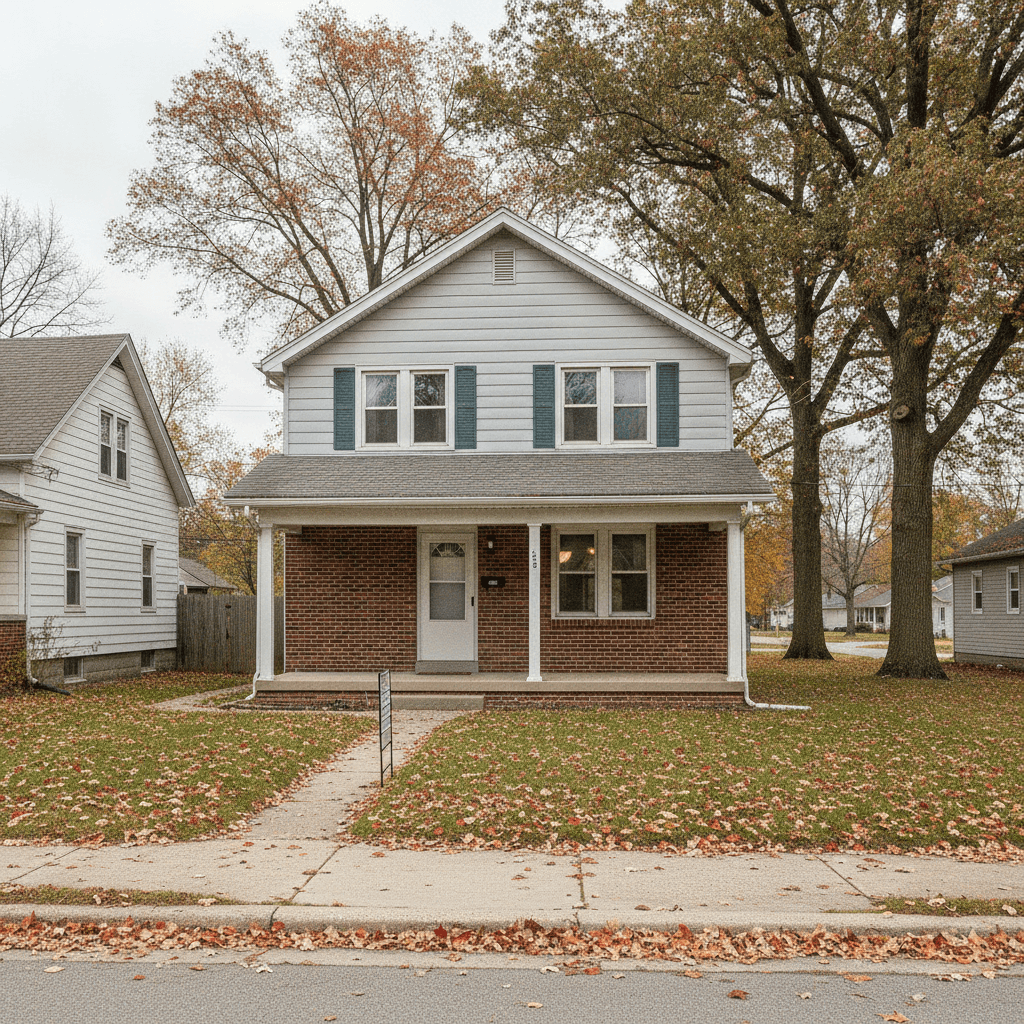
Cleveland homes are sitting on the market longer, inventory is building, and mortgage rates just ticked up again — a combination that quietly hands wholesalers more motivated sellers. If you're working Cuyahoga County, this is the moment to pay attention.
Key Takeaways
- Cleveland's median days on market hit 55 days as of December 2024, up from 30 days in May 2024 — a clear seasonal slowdown.
- Active listings climbed to 3,007 by December 2024, after dipping to 2,145 in April 2024.
- The median listing price was $239,950 in December 2024, down from a $285,000 peak in June 2024.
- The 30-year fixed mortgage rate rose to 6.76% as of September 10, 2026, up from 6.43% in early July 2026.
- Nationally, median days on market sat at 60 days in August 2026, so Cleveland's slower pace is part of a broader trend.
What is the Cleveland real estate market doing right now?
The Cleveland real estate market is cooling from its spring peak — homes are taking longer to sell, more listings are piling up, and prices have eased off their summer highs. That's the short version. Here's the fuller picture.
As of December 2024, Cleveland's median days on market was 55 days, active listings totaled 3,007, and the median listing price was $239,950.
Compare that to just seven months earlier. In May 2024, homes were selling in a median of 30 days — nearly twice as fast. Active listings were only 2,145. And the median list price was $274,250.
So what changed? Seasonality, mostly. Cleveland winters slow everything down. But the swing is bigger than a typical seasonal dip, and that matters for anyone trying to buy below market.
Why the slowdown is bigger than it looks
Look at the gap between spring and winter. Days on market nearly doubled. Active listings jumped by roughly 40% from the April low to the December reading. And list prices fell about 16% from the June peak.
That's not just weather. That's sellers who listed in spring at optimistic prices and are now watching their listings go stale.
Stale listings are a wholesaler's best friend. A seller who's been on the market for 55 days is a seller who's tired.
How many days do Cleveland homes sit on the market?
Cleveland homes sat on the market a median of 55 days in December 2024 — up sharply from the 30-day low in May 2024. The trend line tells the story better than any single number.
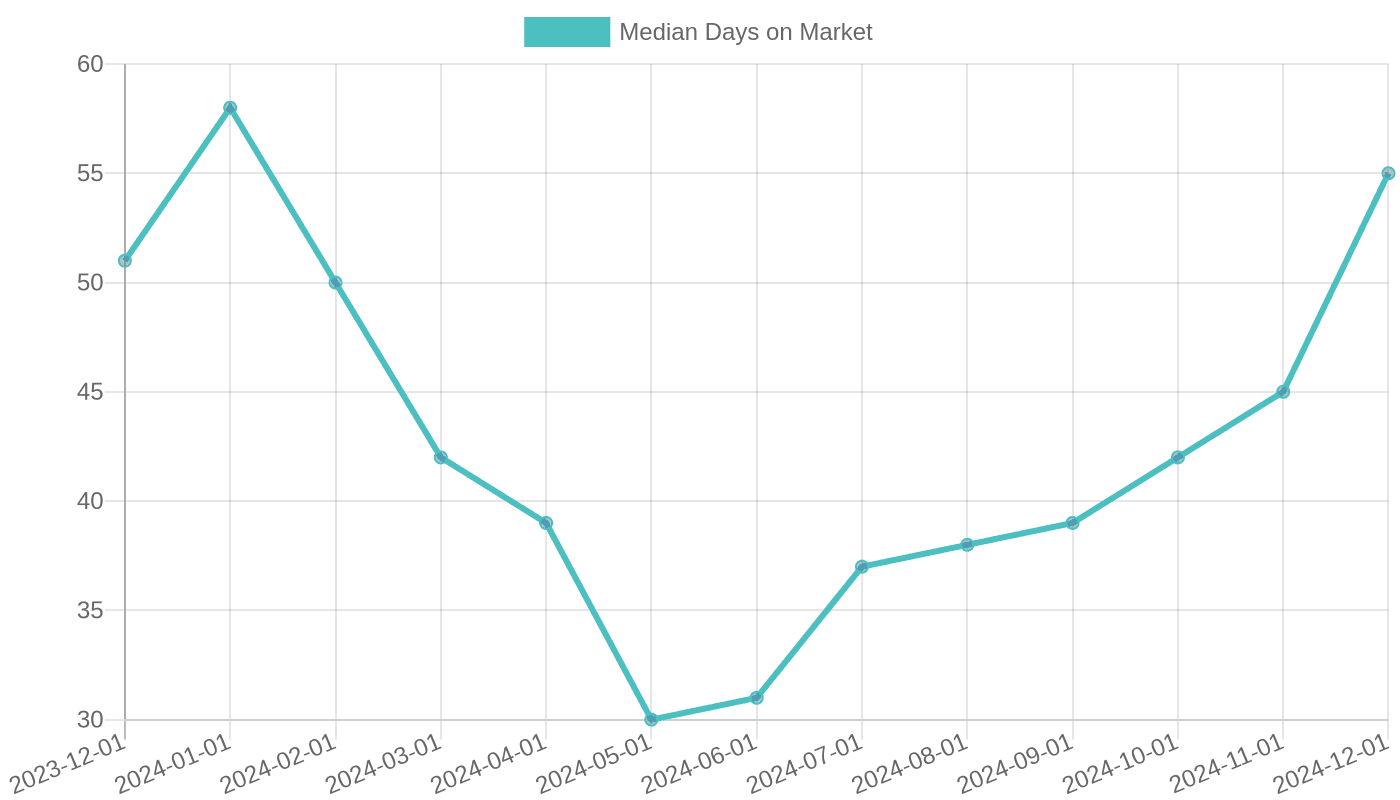
That chart shows the full 2024 arc: 51 days in December 2023, a spring dip to 30 days in May 2024, then a steady climb back to 55 days by December 2024.
Here's what that pattern means in plain English.
- Spring is fast. Buyers come out, listings move, and sellers hold firm on price.
- Fall and winter are slow. Days on market stretch, and sellers start negotiating.
- The stretch is where deals live. Every extra week on market is another week of carrying costs for the seller.
If you're making offers in Cleveland right now, you're making them in the slow window. Use that.
What 55 days means for your offer strategy
A 55-day median tells you the average seller is not getting the rush of showings they expected. That's leverage.
When you talk to a seller who's been listed for 60 or 70 days, you can ask a simple question: "How's the traffic been?" Most will tell you the truth — it's been quiet.
That's your opening. Not a hard pitch. Just a conversation about what happens next.
How many active listings does Cleveland have?
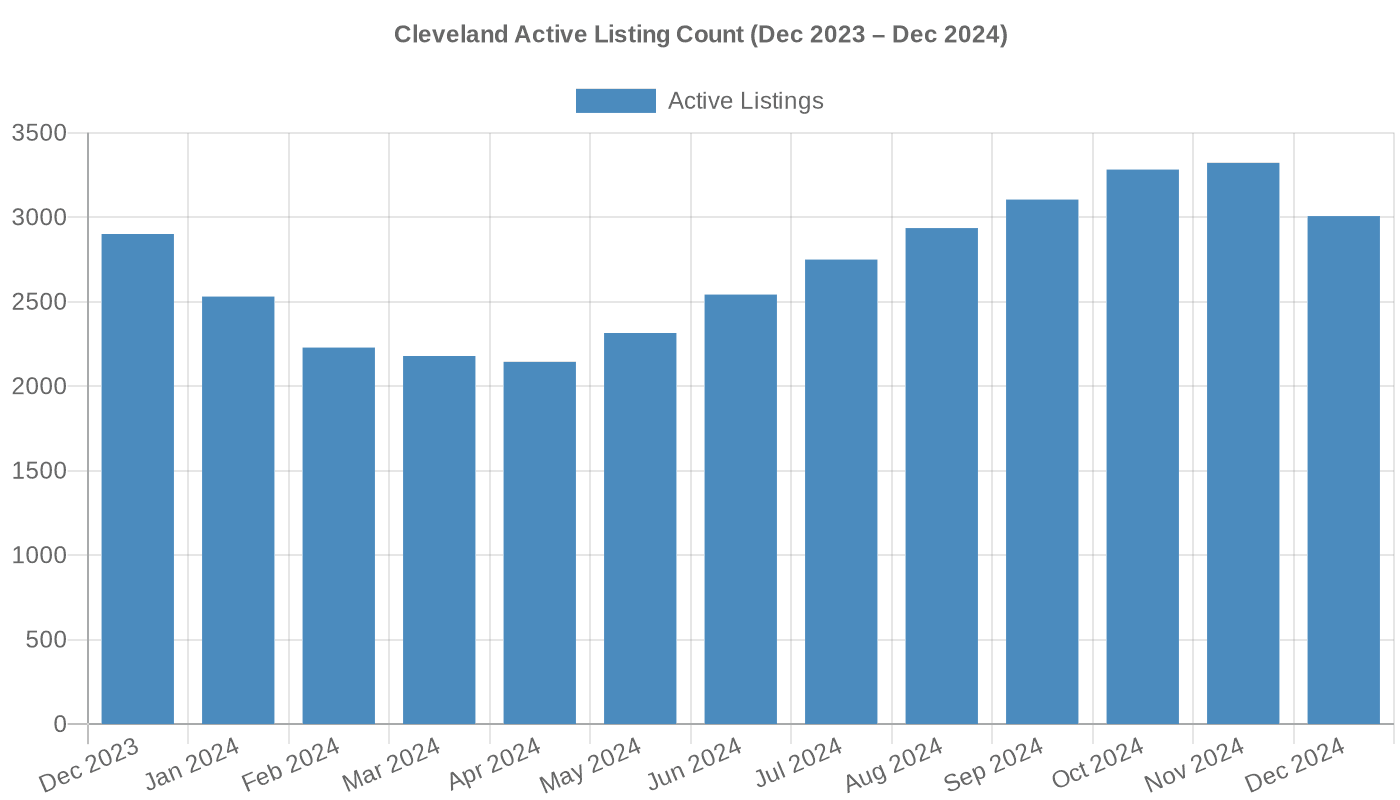
Cleveland had 3,007 active listings as of December 2024. That's up from a spring low of 2,145 in April 2024 — a roughly 40% jump in eight months.
More inventory means more competition for sellers. And more competition means more sellers who are willing to talk about creative options.
The inventory swing, month by month
Here's how the Cleveland listing count moved through 2024:
| Month (2024) | Active Listings | Median Days on Market | Median List Price |
|---|---|---|---|
| April | 2,145 | 39 | $255,250 |
| May | 2,315 | 30 | $274,250 |
| June | 2,543 | 31 | $285,000 |
| July | 2,750 | 37 | $265,000 |
| August | 2,936 | 38 | $269,900 |
| September | 3,105 | 39 | $262,213 |
| October | 3,282 | 42 | $250,000 |
| November | 3,323 | 45 | $249,900 |
| December | 3,007 | 55 | $239,950 |
Notice the pattern. Listings peaked at 3,323 in November, then dropped to 3,007 in December — but days on market kept climbing anyway. That's a sign that the remaining listings were the ones nobody wanted at the asking price.
What this means for your pipeline
When inventory builds and days on market stretch at the same time, you get a specific kind of seller.
- They listed too high.
- They've had few or no offers.
- They're now facing a winter with a vacant or expensive property.
That's the profile you want in your follow-up list.
What is the median listing price in Cleveland?
The median listing price in Cleveland was $239,950 as of December 2024. That's down from the June 2024 peak of $285,000 — a drop of about 16%.
Prices easing doesn't mean the market is collapsing. It means sellers are adjusting to reality. And that adjustment is exactly what creates wholesale margins.
Why price drops create opportunity
When a seller cuts their price, they're admitting the original number was wrong. That admission opens the door to a different kind of conversation.
Instead of "Will you take less?" you can ask, "What would it take to close quickly?"
That reframe matters. It moves the conversation from price to terms — and terms are where wholesalers win.
The national price backdrop
Nationally, the median sales price of houses sold was $410,700 as of April 2026, according to FRED. Cleveland's median list price of $239,950 sits well below that national figure.
That gap is why Cleveland stays attractive to out-of-state investors. You can still buy a house here for less than the national median — often much less.
How are mortgage rates affecting the Cleveland market?
The 30-year fixed mortgage rate rose to 6.76% as of September 10, 2026 — up from 6.43% in early July 2026. That's a meaningful jump in a short window.
That chart tracks the weekly rate from mid-June through mid-September 2026. It bottomed at 6.43% on July 2, then climbed steadily to 6.76%.
Higher rates do two things to your market.
- They cool buyer demand. Fewer people can afford the same payment, so retail buyers pull back.
- They stretch seller timelines. Listings sit longer, and sellers get more anxious.
Both of those push sellers toward options like seller financing, subject-to, and — yes — cash offers from wholesalers.
Why rate headlines matter to your outreach
When the news is full of Fed rate talk, sellers notice. You don't need to explain monetary policy. You just need to acknowledge the reality.
A simple line works: "With rates where they are, a lot of sellers are looking at other options. Is that something you'd want to talk about?"
That's it. No pitch. Just a door.
How does Cleveland compare to the national market?
Cleveland's market is moving in the same direction as the national one — just with its own local flavor. Nationally, median days on market was 60 days as of August 2026, according to FRED.
Cleveland's most recent reading of 55 days (December 2024) was slightly faster than that national pace. But the trend is the same: homes are taking longer to sell than they did during the pandemic-era frenzy.
Cleveland vs. national at a glance
| Metric | Cleveland | National |
|---|---|---|
| Median days on market | 55 days (Dec 2024) | 60 days (Aug 2026) |
| Median list price | $239,950 (Dec 2024) | $410,700 median sales price (Apr 2026) |
| 30-year fixed mortgage rate | — | 6.76% (Sep 10, 2026) |
Cleveland's lower price point is its superpower. You can buy at a fraction of the national median and still find buyers or renters at a spread.
What local wholesalers should watch
Keep an eye on three things:
- Cuyahoga County transfer records. Local outlets publish searchable databases of recent sales — useful for comping your offers.
- Days on market trends. When they stretch past 60, seller motivation climbs.
- Rate direction. Every uptick in rates adds pressure on sellers who need to move.
What tools do Cleveland wholesalers actually need?
The Cleveland market rewards speed and follow-up. The directory tracks 65 tools across 9 categories built for exactly this kind of work — from skip tracing and comping to dialers and CRM.
Here's how to think about your stack.
1. Data and comps
You need accurate sold data for Cuyahoga County. Tools like PropStream and ATTOM Data give you the property records and comps you'll use to build offers.
2. Lead generation
Motivated seller lists, absentee owner lists, and pre-foreclosure data all feed your pipeline. Televista Lead Generation is one option in the directory.
3. Outreach and follow-up
This is where most wholesalers lose deals. A dialer like CallTools or a CRM like GoHighLevel keeps your follow-up consistent.
4. Deal management
Once you've got a contract, you need a system to track it. Launch Control is built for that stage.
A simple stack for a Cleveland wholesaler
- Data: PropStream or ATTOM Data
- Leads: Televista Lead Generation
- Dialer: CallTools
- CRM: GoHighLevel
- Deal tracking: Launch Control
You don't need all five on day one. Start with data and a dialer. Add the rest as your pipeline grows.
What should wholesalers do differently this fall?
The single biggest shift is this: stop chasing the spring playbook. In a slower market, speed of follow-up beats volume of cold outreach.
Here's a practical plan for the next 90 days.
- Pull a fresh list of 60+ day listings. These are your warmest leads.
- Call every one of them within 48 hours. Stale listings go fast when someone finally shows interest.
- Lead with the market reality. "Homes are sitting longer — have you thought about other options?"
- Follow up every 7 days. Not every day. Every week. Consistency beats pressure.
- Track your conversations. If you're not logging calls, you're guessing.
Why consistency wins in a slow market
In a fast market, sellers come to you. In a slow market, you have to stay in front of them.
The wholesalers who win in Cleveland this fall won't be the ones with the biggest lists. They'll be the ones who actually work the lists they have.
The Bottom Line
Cleveland's market is giving wholesalers a clear window: 55 median days on market, 3,007 active listings, and a $239,950 median list price — with mortgage rates at 6.76% adding pressure on sellers who need to move. The opportunity is real, but it only pays off if your follow-up is sharp. Before you start dialing that stale-listing list, practice a few calls against a realistic AI seller with our free AI Cold Call Trainer — it takes no signup to start.
Frequently Asked Questions
What is the median days on market in Cleveland right now?
Cleveland's median days on market was 55 days as of December 2024, according to Realtor.com data via FRED. That's up from a 30-day low in May 2024, showing a clear seasonal slowdown.
How many active listings does the Cleveland market have?
Cleveland had 3,007 active listings as of December 2024. That's up from a spring low of 2,145 in April 2024, a roughly 40% increase in eight months.
What is the median listing price in Cleveland?
The median listing price in Cleveland was $239,950 as of December 2024. That's down from the June 2024 peak of $285,000, a drop of about 16%.
How are mortgage rates affecting the Cleveland real estate market?
The 30-year fixed mortgage rate rose to 6.76% as of September 10, 2026, up from 6.43% in early July 2026. Higher rates cool buyer demand and stretch seller timelines, which pushes more sellers toward creative financing and cash offers.
Is Cleveland a good market for real estate wholesalers?
Yes — Cleveland's median list price of $239,950 sits well below the national median sales price of $410,700, and rising days on market give wholesalers more motivated sellers to work with. The key is consistent follow-up on stale listings.
What tools do Cleveland wholesalers need most?
Most Cleveland wholesalers start with property data and comps tools like PropStream or ATTOM Data, then add a dialer like CallTools and a CRM like GoHighLevel for consistent follow-up. The directory tracks 65 tools across 9 categories to help you build your stack.
Sources
- Cleveland: Median days on market — Realtor.com via FRED
- Cleveland: Active listing count — Realtor.com via FRED
- Cleveland: Median listing price — Realtor.com via FRED
- 30-Year Fixed Mortgage Rate — FRED (Federal Reserve Bank of St. Louis)
- Median Sales Price of Houses Sold — FRED (Federal Reserve Bank of St. Louis)
- Median Days on Market (national) — FRED (Federal Reserve Bank of St. Louis)
- Software tools tracked in the Wholesale REI directory — Wholesale REI directory
- Tool categories in the Wholesale REI directory — Wholesale REI directory
This article was researched and drafted with AI assistance, then reviewed and edited by Mark Anthony. Every statistic is sourced and cited. It's for informational purposes only and is not financial or legal advice. Read our editorial policy.